
Why Do Onions Make You Cry? The Science, Explained for Kids
Cutting an onion sets off a tiny chemical reaction that makes a gas your eyes try to wash away. Here is what happens, why cooked onions do not sting, which tear-stopping tips work, and a simple onion experiment to try with kids.
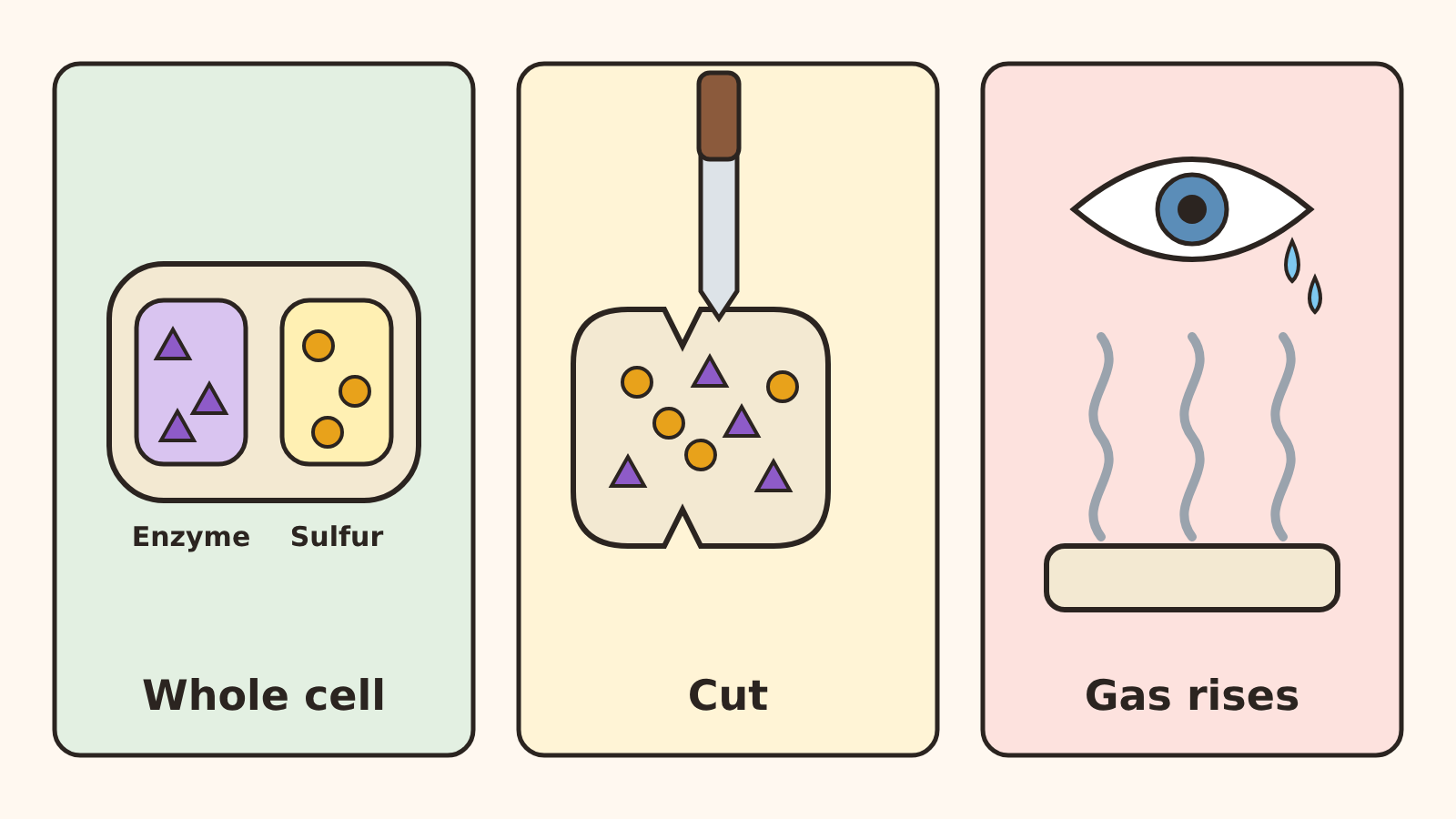
Onions make you cry because cutting one starts a tiny chemical reaction. Slicing breaks open the onion's cells, two sets of chemicals that were kept apart mix, and within seconds they make an irritating gas that drifts up into your eyes. Your eyes sense it and flush it away with tears. A whole onion sitting on the counter can't do this, which is why it only happens once the knife goes in.
What happens inside an onion when you cut it
An onion is made of millions of cells, and each one is like a tiny water balloon with compartments inside. Some compartments hold sulfur-containing compounds. Others hold enzymes, which are proteins that speed up chemical reactions. While the cell is whole, the two never meet.
A knife changes that. When a cell is crushed or sliced, its walls burst and everything spills together:
- An enzyme called alliinase gets to work on the sulfur compounds and turns them into a new, unstable chemical.
- A second enzyme, called lachrymatory-factor synthase, quickly turns that chemical into a gas with a long name: syn-propanethial-S-oxide. Scientists call it the "lachrymatory factor", from the Latin word for tears.
- The gas is light and evaporates straight off the cut surface, so it rises toward whoever is standing over the chopping board.
That second enzyme was a fairly recent discovery. For a long time, scientists thought alliinase did the whole job. In 2002, a team of researchers in Japan led by Shinsuke Imai published a short paper in the journal Nature showing that a separate enzyme is needed to make the tear-causing gas. Its title sums it up nicely: "An onion enzyme that makes the eyes water."
Why the gas makes your eyes water
The front of your eye is covered with very sensitive nerve endings. Their job is to notice anything that could harm the eye, like dust, smoke or an irritating chemical. When the onion gas lands on your eye, those nerves send a signal, and the tear glands respond by making extra tears to wash it away.
So the tears are your body doing its job. They're the same reflex that kicks in when you get a speck of dust in your eye. The stinging fades quickly once you step away and the gas clears.
Why cooked onions don't make you cry
Enzymes are proteins, and heat changes their shape so they stop working. Once an onion is cooked, alliinase and lachrymatory-factor synthase can't make the gas any more, which is why frying onions smell sweet and savoury but don't sting. The same idea explains why a soft cooked onion tastes so much milder than a raw slice: many of the sharp-tasting sulfur chemicals only form when the raw cells are broken.
Garlic has a related reaction. When you crush a garlic clove, alliinase makes allicin, the compound behind raw garlic's sharp smell. Garlic doesn't have the second enzyme, though, so it doesn't make the tear gas. That's why chopping garlic smells strong but doesn't make you cry.
Tips that help, and ones that don't
Because the tears come from a chemical reaction and a gas, the tricks that help either slow the reaction, break fewer cells, or keep the gas away from your eyes.
- Chill the onion first. Putting an onion in the fridge for about 30 minutes before you cut it helps many people. Chemical reactions run slower in the cold, and less of the gas evaporates from a cold cut surface.
- Use a sharp knife. A sharp blade slices cleanly through cells, while a dull one crushes and bursts many more of them, releasing more of the chemicals.
- Keep your face back and let air move. Cutting near an open window or under a running kitchen fan moves the gas away before it reaches you.
- Wear goggles. Swim goggles or kitchen goggles that seal around the eyes work because the gas can't get in. Kids usually find this the funniest fix.
Plenty of other tips get passed around: holding a piece of bread in your mouth, chewing gum, lighting a candle nearby. There's no good evidence that any of these work, so treat them as kitchen folklore. If a family member swears by one, it makes a fun thing to test.
Try it at home: the onion tear test
This is a simple experiment for curious kids, and it turns a cooking chore into a bit of science. An adult does all the cutting with a sharp knife.
You need two onions of the same kind and size, a cutting board, a sharp knife and a timer.
- Put one onion in the fridge for 30 minutes. Leave the other at room temperature.
- Ask your kids to predict which one will make the cutter's eyes water more, and why.
- The adult cuts the room-temperature onion in half and slices it, while a child starts the timer and notes how many seconds pass before the cutter's eyes start to sting.
- Step away, let the air clear and rinse your hands.
- Repeat with the chilled onion and compare the times.
It's not a perfect test, since the cutter's eyes may still be sensitive the second time. Kids aged 8 and up can talk about how to make it fairer, such as swapping the order on another day or using a different person as the cutter. That's real scientific thinking.
A word on safety: kids should keep their hands and faces back from the board while an adult cuts. If they're old enough to practise knife skills, the kitchen jobs by age in our pizza guide show what's sensible at each stage. Raw onion can be a choking risk for children under 4 if it's in large or hard pieces, so cook it until soft or chop it very finely for little ones.
Put your onions to work
Once everyone knows why the tears come, onion chopping becomes a lot less mysterious. Next time you're slicing an onion for sheet-pan chicken fajitas, try one of the tricks above and see whether it makes a difference in your kitchen.
