Why Does Popcorn Pop? The Science Inside Every Kernel, Plus a Kids Test
Every popcorn kernel is a tiny pressure cooker: water turns to steam inside a tough hull until it bursts. Here is what happens, why some kernels never pop, a pricked-kernel test to try with kids, and the popcorn legend to check at Thanksgiving.
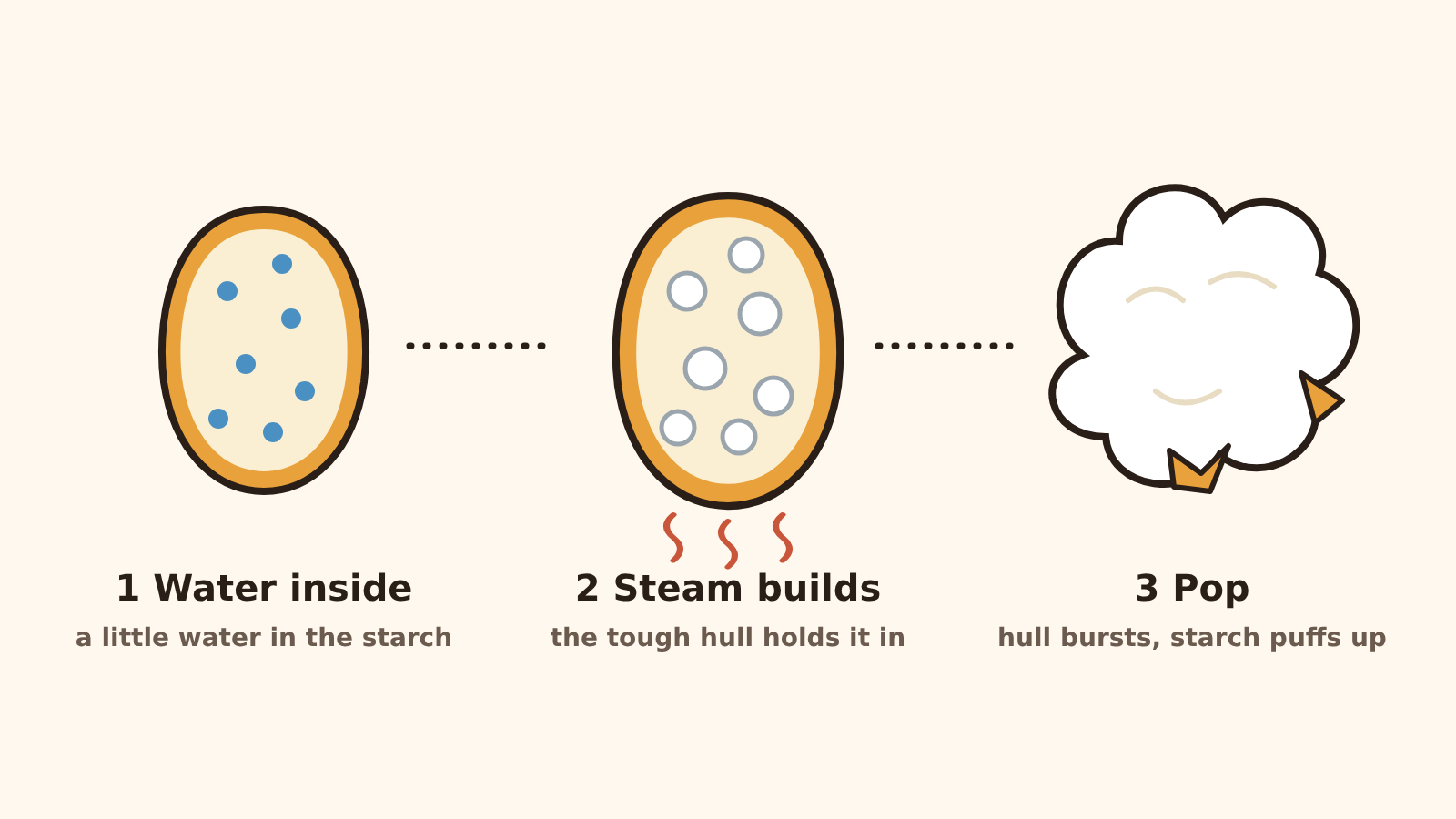
Popcorn pops because every kernel is a tiny pressure cooker. Inside its hard, shiny shell is a little water mixed into soft starch. When the kernel gets hot, that water turns to steam, but the shell is tough enough to hold it in, so the pressure keeps rising. At a certain point the shell gives way all at once, the steam rushes out, and the hot starch puffs up into the white, crunchy foam we eat.
What is inside a popcorn kernel
Popcorn is a particular kind of corn, not the sweet corn you eat off the cob, and only some corn will pop at all. A popcorn kernel has three main parts:
- The hull: the hard, shiny outer layer. In popcorn it is unusually strong and seals the kernel well.
- The starchy inside, packed with tiny grains of starch and a small amount of water.
- The germ, the small part at the pointed end that would grow into a new corn plant if you planted it.
That combination is what makes popcorn special. Other kinds of corn have a weaker or leakier hull, so when they heat up the steam seeps out slowly and nothing dramatic happens.
What happens when it pops
As the kernel heats up in a hot pan or the microwave, three things happen in a few seconds (the picture at the top shows them in order):
- The water turns to steam. Steam takes up far more space than the water it came from, so pressure builds inside the sealed hull.
- The starch softens. The heat and moisture turn the hard starch into a hot, soft, gooey mass, a bit like very thick dough.
- Then the hull bursts. When the pressure gets too much, the hull splits open. The soft starch puffs out as the steam expands, then cools and sets almost instantly into the crisp white foam.
In 2015, two French researchers, Emmanuel Virot and Alexandre Ponomarenko, filmed popping kernels with a high-speed camera and published what they saw in the Journal of the Royal Society Interface. They found that kernels popped at around 180°C (356°F). They also found that the "pop" sound is not the hull cracking. It comes from the burst of steam escaping, a bit like the sound of a cork coming out of a bottle. Their footage showed something else funny: a kernel jumps because part of the starch puffs out first like a little leg, pushes against the pan and flips the kernel into the air.
The puffed starch can come out in different shapes. Popcorn sold for movie theaters is usually the "butterfly" kind, with lots of wings, while "mushroom" popcorn pops into rounder balls that hold up better when it is coated in caramel.
Why some kernels never pop
Every bowl has a few hard kernels left at the bottom (popcorn fans call them "old maids"). There are two main reasons:
- The hull leaked. If there is a crack or weak spot, steam escapes as fast as it forms, and pressure never builds. Food scientists at Purdue University, led by Bruce Hamaker, reported in 2005 that the structure of the hull is what decides how well a kernel holds its moisture and pops, which is why unpopped kernels are so often the ones with a leaky hull.
- The kernel was too dry. Old popcorn left open in the cupboard slowly loses water. With less water inside, there is less steam to build up pressure. That is why it is worth keeping popcorn kernels in a sealed jar.
The same idea, gas trapped inside something stretchy until it puffs up, is what makes bread rise in the oven. Bread uses carbon dioxide from yeast and a stretchy gluten net instead of steam and a hard hull.
Try it: the pricked kernel test
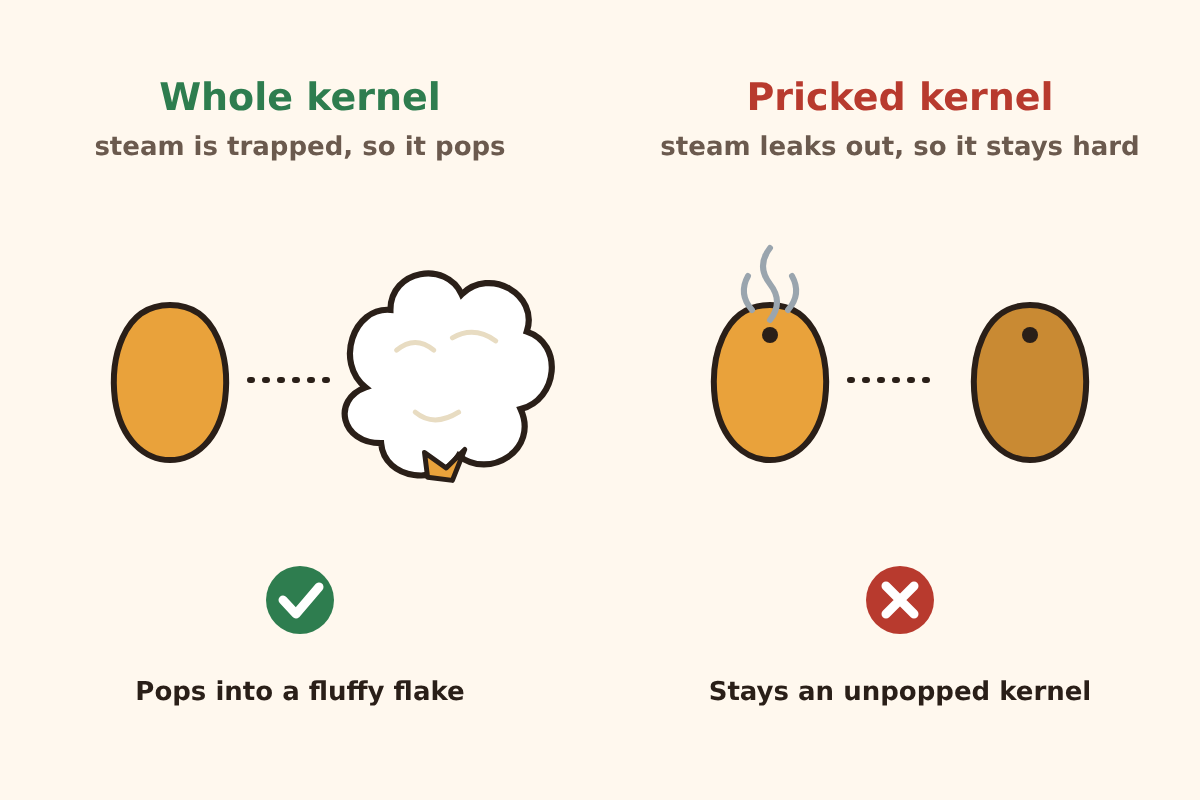
You can test the "tiny pressure cooker" idea at home with a few kernels.
You need: about 40 popcorn kernels, a sewing needle or pushpin, 1 tbsp (15 ml) vegetable oil, a small pot with a lid, and two bowls.
- Count and sort (kids): count out two piles of 20 kernels. Kids aged 4 and up can do this, and it is good counting practice.
- Make the holes (adult or teen): carefully push the needle into each kernel in one pile, just through the hull. Kernels are hard and slippery, so press each one into a folded kitchen towel to hold it. Younger kids can watch.
- Make a guess (everyone): ask how many of each pile everyone thinks will pop. Write the guesses down.
- Pop the whole kernels (adult): heat the oil in the pot over medium-high heat with the lid on. Add the 20 whole kernels, put the lid back on and shake the pot gently. When the popping slows to a few seconds between pops, take it off the heat and tip everything into a bowl.
- Pop the pricked kernels (adult): wipe the pot, add fresh oil and repeat with the pricked pile, cooking for the same amount of time.
- Count again (kids, once it has cooled): count how many unpopped kernels are left in each bowl.
You should find many more hard kernels in the pricked bowl, because the steam had a way out. Exact numbers will vary from one bag of popcorn to the next, which makes it a nice test to repeat. If you enjoy kitchen experiments like this, the apple browning test works the same way, comparing slices side by side.
An adult should handle the hot oil and the pot. Popped kernels and the oil are very hot, and steam escaping when you lift the lid can burn, so tilt the lid away from your face.
Popcorn safety for little kids
Popcorn is fun to make with children of any age, but it is not a food for young children to eat. The American Academy of Pediatrics lists popcorn among the foods that are a choking risk for children under 4, because the light, hard pieces and unpopped kernels are easy to breathe in by accident. Let little ones count, watch and listen to the pops from a safe distance, and give them a different snack.
Popcorn history: what is true and what is a legend
Popcorn is old. In 2012, a team of archaeologists including researchers from the Smithsonian Institution reported in the journal PNAS that they had found corn cobs and popcorn at two ancient sites on the coast of Peru, dated to about 6,700 years ago. That makes it one of the earliest known ways people ate corn.
You may hear that popcorn was served at the 1621 harvest feast in Plymouth that is often called the first Thanksgiving. That story is a legend. The best-known first-hand account of the feast, a letter by the colonist Edward Winslow, mentions birds and five deer and says nothing about popcorn, and there is no record of it being eaten there. It makes a good dinner-table question this month: ask the family whether they think it is true, then tell them what historians found.
For more kitchen science to share at the table, here is why onions make you cry.
