Why Do Apples Turn Brown? The Science, Plus an Easy Kitchen Test
Cut apples turn brown when an enzyme meets oxygen. Here is what happens inside the fruit, why lemon juice stops it, whether brown apples are safe, and a four-plate kitchen test to try with kids.
A cut apple turns brown because cutting lets an enzyme inside the fruit meet oxygen from the air. Together they turn natural chemicals in the apple, called phenols, into brown pigment. It starts within minutes, it's harmless, and you can slow it right down with a squeeze of lemon. It also makes one of the easiest kitchen experiments there is.
What happens when you cut an apple
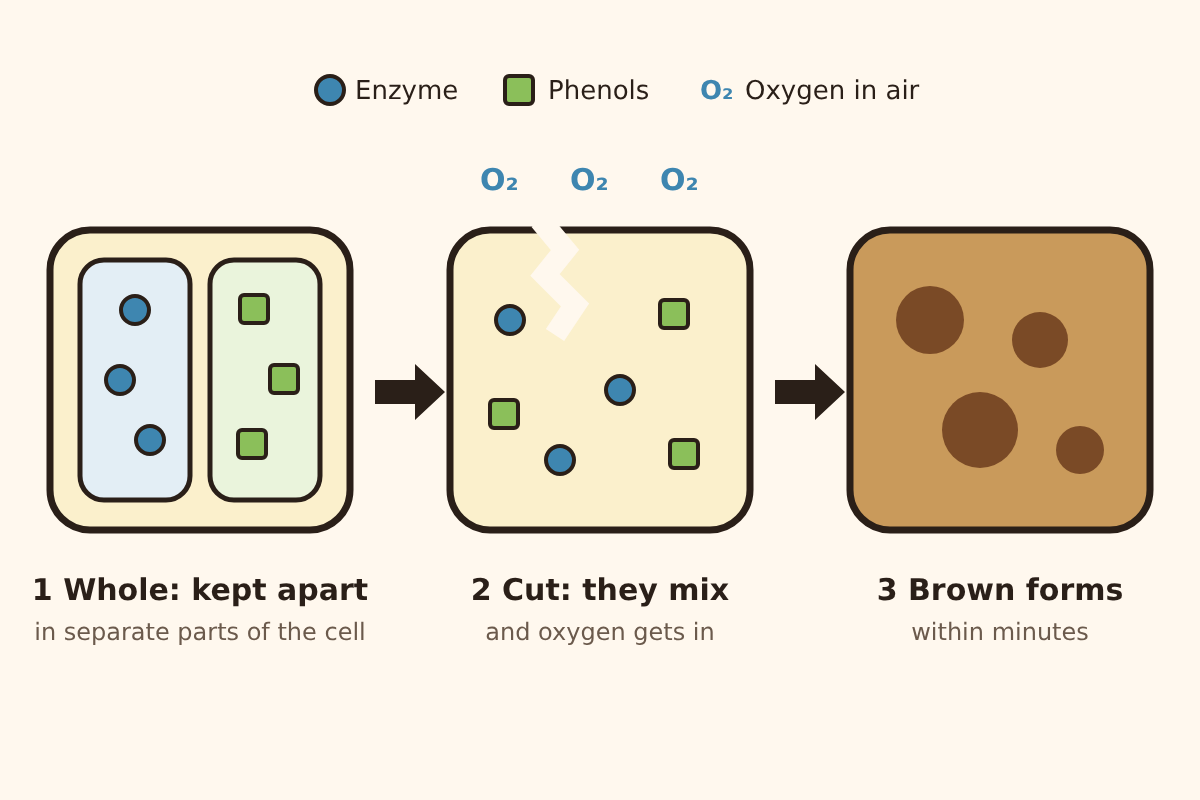
An apple is built from millions of tiny cells. Inside each one, an enzyme called polyphenol oxidase (food scientists shorten it to PPO) is stored in one part of the cell, and the phenols it works on are stored in another. While the apple is whole, they stay apart.
A knife, a bite or a bruise breaks those cells open. The enzyme and the phenols spill together, and oxygen from the air rushes in. The enzyme uses that oxygen to change the phenols into new chemicals called quinones, which quickly link up into brown pigments. Food scientists call the whole process enzymatic browning, and Harold McGee's well-known kitchen science book On Food and Cooking uses apples, bananas and avocados as the classic examples.
That's why the brown shows up only on the cut face and why a bruised spot on an uncut apple goes brown too: a bump breaks cells under the skin in the same way.
Is a brown apple safe to eat?
Yes. Browning changes the colour and can make the surface taste a little flat, but it doesn't mean the apple has gone off. A brown slice in the lunchbox is the same apple, just a different colour. Mould, a mushy texture or a sour, fermented smell are the signs of fruit that's spoiled, and those are different from browning.
Why lemon juice stops it
The enzyme behind browning works best in fruit's normal, mildly acidic conditions. Lemon juice does two things to it:
- It makes the surface more acidic, and PPO slows down a lot when things get more acidic.
- It adds vitamin C. Vitamin C (ascorbic acid) turns the quinones back before they can link up into brown pigment, so the brown never forms while the vitamin C lasts.
This is why the USDA-funded National Center for Home Food Preservation tells home cooks to use ascorbic acid to stop cut fruit darkening while they freeze or can it. Orange juice and pineapple juice work in the same way, with milder results, and they taste sweeter on a slice.
Salt water slows browning too: salt gets in the enzyme's way. Many cooks soak apple slices for a few minutes in lightly salted water and rinse them before packing. It works, but the slices taste faintly salty if you skip the rinse.
Cold and heat change it too
Like most chemical reactions, browning runs slower in the cold. Cut apple keeps its colour longer in the fridge than on the counter, though it still browns in the end.
Heat goes further: it stops the enzyme for good. Enzymes are proteins, and heat changes their shape so they can't work. The National Center for Home Food Preservation explains that this is why vegetables are blanched in boiling water before freezing. It's also the same reason cooked onions don't make you cry: the enzymes that make the tear gas stop working once the onion is hot.
Try it at home: the apple browning test
This takes ten minutes to set up and about an hour to watch. Kids aged 8 and up can cut the slices with a small knife while an adult watches; for younger kids, an adult cuts and kids do everything else. If they're new to knives, our first knife skills fruit salad shows the grips to teach.
You need:
- 1 apple
- 4 small plates or bowls
- 1/4 cup (60 ml) water in a cup
- 1/4 cup (60 ml) water with 1/8 tsp (about 0.7 g) salt stirred in
- 1 tbsp (15 ml) lemon juice
- A clock or timer
Steps:
- Cut the apple into slices of about the same thickness. Put one or two on each plate straight away.
- Leave the first plate alone. That's the control.
- Dip the second plate's slices in plain water for 1 minute and drain them.
- Dip the third plate's slices in the salt water for 1 minute and drain them.
- Brush or spoon lemon juice over the fourth plate's slices.
- Look at all four after 10 minutes, 30 minutes and 1 hour. Line them up and decide which is brownest.
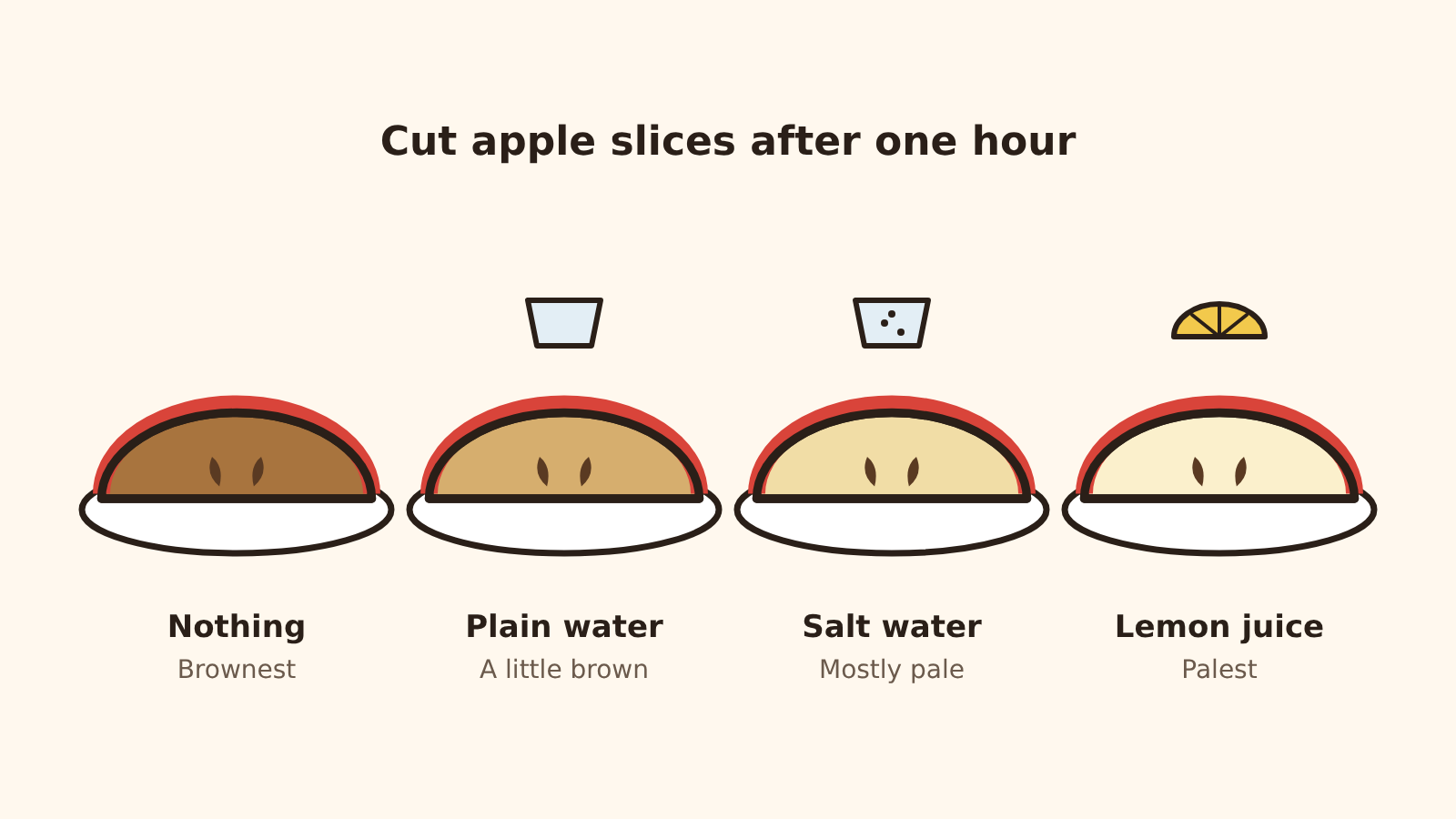
In most kitchens, the untreated slice browns first and darkest, the plain water slice a little less, salt water clearly less, and lemon juice least of all. Your results may not match exactly: different apple varieties brown at different speeds, so a great follow-up test is two different apples, both left untreated, side by side.
Good questions to ask at the table: why did plain water help a little? (It kept air off the surface for a minute.) What would happen if you put a slice in the fridge? What about a slice of banana or pear?
The tasting is the fun part. All four slices are fine to eat.
Where else you'll see the same reaction
Once you know what browning looks like, it turns up everywhere: bananas going brown, the cut face of an avocado, a peeled potato left out on the board, sliced mushrooms and pears. Black tea gets its colour from the same kind of enzyme reaction, which tea makers let happen on purpose after the leaves are rolled.
Some scientists have taken the opposite approach and switched the enzyme off at its source. The USDA approved the first non-browning apples, sold as Arctic apples, for growing in 2015. They were engineered to make much less PPO, so their slices stay pale for much longer.
If you liked this, the same "what's happening inside the food" idea explains why bread rises, and it makes an easy science topic to bring to the table with an apple in hand.
